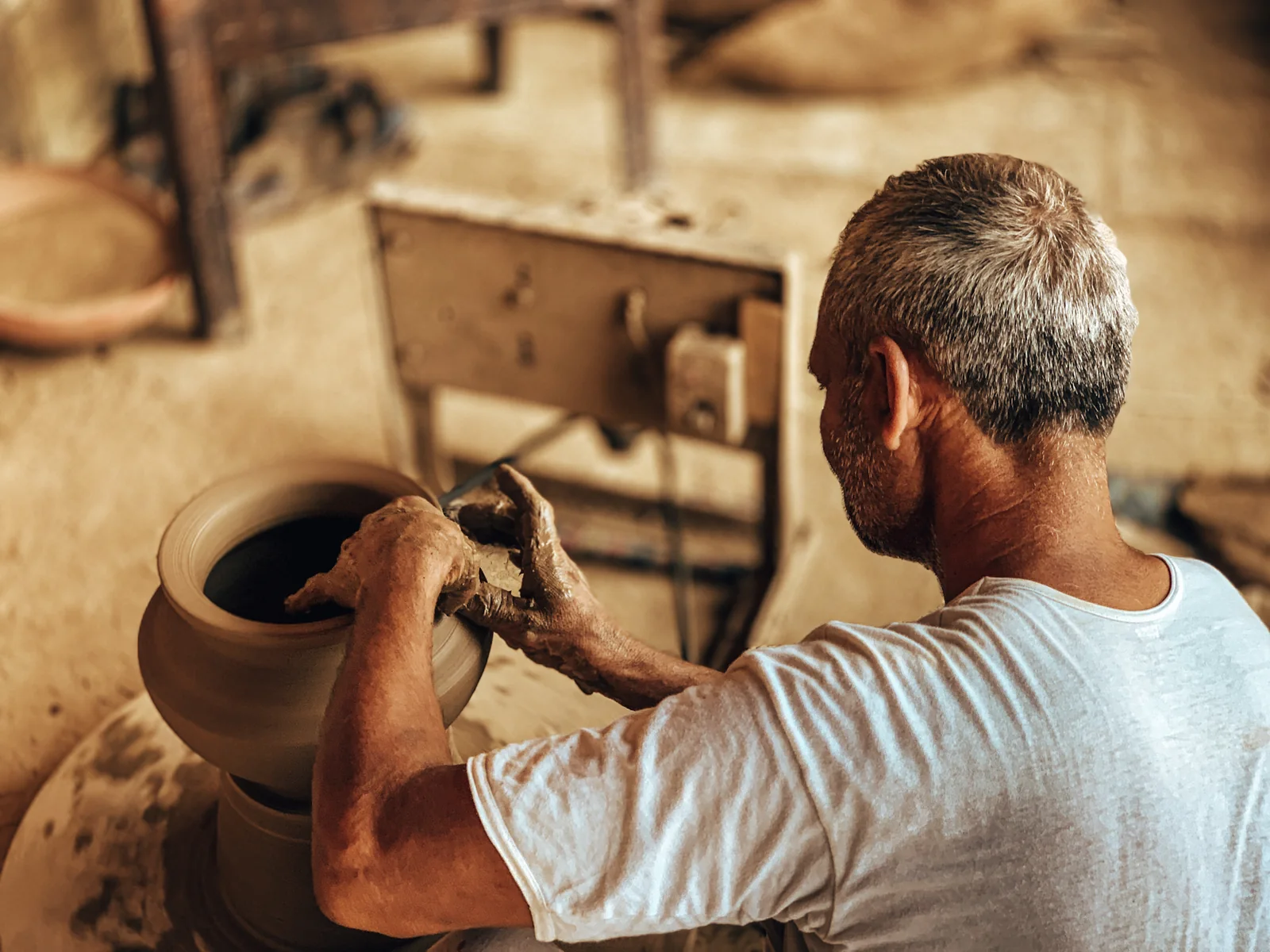
For more than four decades, Arjan Singh has shaped ordinary clay into something meaningful. Behind every vessel he creates lies a tradition carried through five generations, a lifetime of honest work, and the quiet determination of a man who believes that the greatest wealth comes not from what we earn, but from the respect we hold for our work.
Some stories are not found in grand places or extraordinary achievements. They exist in small workshops, among familiar streets, and in the hands of people who have spent their entire lives practising a craft that the world is slowly learning to forget.
In the town of Bhagta Bhai, Panjab, lives one such man.
His name is Arjan Singh, a sixty-five-year-old traditional potter whose life has revolved around the simple yet remarkable art of transforming clay into everyday vessels.
For approximately forty to forty-five years, he has worked with मिट्टी, the earth that has provided his family with a livelihood for generations. What appears to others as an ordinary occupation carries a much deeper meaning for him.
It is not simply the work he does. It is the inheritance he carries.
According to Arjan Singh, pottery has been practised in his family for nearly five generations. His father, grandfather, and great-grandfather were all connected to the same craft, passing their knowledge from one generation to the next.
Long before modern machinery and mass-produced household goods became common, these hands were shaping clay into objects that formed an essential part of everyday life.
And even today, when traditional pottery faces increasing competition from manufactured alternatives, Arjan Singh continues to practise the occupation his ancestors once depended upon.
He does not want this journey to end with him.
He hopes that the next generation of his family will remain connected to pottery, carrying forward the knowledge, patience, and traditions that have survived for so many years.
There is something deeply meaningful about that wish.
In a world where people are often encouraged to leave behind traditional occupations in search of better opportunities, Arjan Singh sees value in preserving what his family has already built.
For him, progress does not necessarily mean walking away from the past. Sometimes, it means taking what previous generations have given us and finding a way to carry it into the future.
“Some people inherit wealth, others inherit land. Arjan Singh inherited a craft, and spent his life proving that it was worth preserving.”
His journey, however, has not been without challenges.
Traditional pottery is not an occupation that guarantees a fixed income. Some days, the demand for his products is high, and business moves faster than expected. On other days, the vessels he has carefully prepared remain unsold.
There is uncertainty in the work, and there always has been.
Yet Arjan Singh has never allowed these difficulties to convince him that his occupation is without value.
Over the years, through patience, discipline, and consistent effort, he has managed to build a comfortable and fulfilling life.
The earnings from pottery have helped him construct a good home and provide his family with the comforts and necessities of everyday living.
His story challenges a belief that is often repeated about traditional occupations: that they cannot provide a respectable livelihood.
Arjan Singh's experience suggests otherwise.
He has spent decades working with clay, and although his income has never been entirely predictable, his dedication has allowed him to create a life of stability and contentment.
He has never needed to abandon his profession to prove that he could succeed.
Instead, he has allowed his work to speak for itself.
Arjan Singh has two brothers who were also involved in the family's traditional occupation. Both eventually decided to leave pottery after practising it for some time.
Arjan Singh, however, chose to continue.
While others moved towards different paths, he remained connected to the craft that had shaped his family's identity for generations.
His decision was not simply about earning a living. It was also about protecting something that might otherwise have disappeared.
Every time he prepares another clay vessel, he continues a tradition that began long before his own lifetime.
And perhaps that is what makes his work so significant.
The objects he creates may eventually be sold, used, broken, or replaced, but the knowledge behind them belongs to a much longer story.
A story of ancestors who worked with the same material, learned through the same patience, and passed their skills to the generations that followed.
Today, Arjan Singh stands as one of the people keeping that story alive.
What stayed with me most about him, however, was not only his craftsmanship or the number of years he had spent practising it.
It was his simplicity.
Despite everything he has achieved through his work, Arjan Singh continues to live with humility, gratitude, and a deep sense of contentment.
He speaks about his occupation with respect, acknowledging that pottery has given him much more than a source of income.
It has provided him with a home, a livelihood, and the satisfaction of knowing that he has remained faithful to the work of his ancestors.
There is no sense of bitterness in the way he describes the uncertainty of his profession.
He understands that some days will be better than others. Some seasons will bring greater demand, while others will require more patience.
But he accepts these changes as part of the journey.
His outlook reflects a principle deeply rooted in Punjabi culture and Sikh teachings: Kirat Karni, the practice of earning an honest living through sincere effort.
For Arjan Singh, work is more than a responsibility. It is an expression of gratitude towards the life he has been given.
He believes that a person should continue working with honesty, remain patient through difficulties, and place trust in Waheguru.
The results of our efforts may not always be within our control, but the sincerity with which we perform them certainly is.
“His hands work with the earth, but his faith has always remained in the One who created it.”
There is a quiet wisdom in this way of living.
We spend much of our lives worrying about what we have not achieved, comparing our circumstances with others, and searching for opportunities that promise greater rewards.
Arjan Singh's story offers a different understanding of success.
He does not measure his life only through financial gain. He finds satisfaction in the home he has built, the family he has supported, and the generations-old tradition he continues to protect.
His wealth is not limited to what he possesses.
It also exists in his patience, his faith, and the respect he has maintained for his occupation throughout his life.
When I think about Arjan Singh, I am reminded that determination does not always announce itself through extraordinary achievements.
Sometimes, it appears in the simple decision to return to the same work every morning, even when yesterday's efforts brought little reward.
Sometimes, it is found in the courage to continue a family tradition when others have chosen to leave it behind.
And sometimes, it exists in the belief that honest work, no matter how ordinary it may appear, carries its own dignity.
Arjan Singh has spent more than four decades proving exactly that.
He has built a comfortable life without turning his back on his roots. He has remained devoted to a profession whose future is uncertain, and he continues to hope that the generations after him will recognise its value.
There is something admirable about a person who does not see his heritage as a burden, but as something worth protecting.
As I reflect on his journey, I find myself thinking about the countless traditional craftsmen across Panjab whose stories remain largely untold.
They are the people who have preserved our cultural identity through their everyday work.
They may never receive widespread recognition, and their names may never appear in history books, but their contributions remain woven into the lives and traditions of our villages and towns.
Arjan Singh is one of them.
His story is not simply about pottery. It is about patience, gratitude, and the quiet strength required to remain faithful to one's beginnings.
It is about a man who chose to preserve the work of his ancestors while building a meaningful life for himself and his family.
And above all, it is a reminder that progress does not always require us to leave our roots behind.
Sometimes, the greatest achievement is to help those roots grow deeper.
I went to learn about a man who makes vessels from clay. I came away with the story of someone who has spent his life protecting an inheritance that cannot be measured in money.
Five generations of knowledge, decades of honest labour, and a belief that the work of our hands should always be treated with dignity.
There is a certain beauty in the thought that the same earth which supported his ancestors continues to support him today.
And as long as those hands keep shaping clay, a part of their story will continue to live.
Some people spend their lives searching for where they belong. Others spend their lives honouring where they came from.